
Emergency Water Heater Repair in Greer, SC
Leaking tank, no hot water or a gas smell? Start with the safety steps below, then call and stay on the line to be connected with a local water heater specialist who serves Greer.
Emergency water heater repair: first 5 steps when your water heater fails
Most emergency water heater repair calls come down to a leak, a loss of hot water, or a gas or burning smell. The order below keeps you safe first and limits damage second.
- Smell gas, or hear hissing near a gas line? Leave the house right away, do not touch light switches or start anything electrical, and call 911 from outside. Then call your gas provider. If your gas comes from Greer CPW, its number is 864-848-5500.
- Cut power or gas to the heater. For an electric heater, switch off its breaker in the panel. For a gas heater with no gas smell, turn the gas control knob to off.
- Shut the cold-water supply. Close the valve on the cold pipe that feeds the top of the tank. If it will not turn, close the main water valve for the house.
- Keep people and pets out of the water. Do not stand in a pool of water near outlets, the panel or appliances. Move stored boxes off the floor and start soaking up water with towels.
- Call and describe what you see. Use the checklist further down so the specialist can tell you what is a repair and what is not.
Do not open the drain valve right after a failure. The water in the tank can be hot enough to scald, so let it cool before anyone drains it.
Is it an emergency water heater repair or can it wait?
Not every water heater problem needs a midnight call. This split helps you decide.
Call right away if you see
- Water leaking steadily from the tank, or pooling near an outlet, the panel or other appliances
- A gas smell, a hissing gas line, soot or scorch marks near the burner or vent (call 911 from outside first)
- A carbon monoxide alarm sounding (get everyone outside and call 911)
- The relief valve pipe discharging steadily, or the tank hissing, banging or rumbling hard
- Hot water that comes out scalding hot at the faucets
Usually fine to call during normal hours
- Lukewarm water, or hot water that runs out faster than it used to
- A small drip at a fitting or valve that stops when you close the cold-water supply
- Rust-colored hot water, a metallic taste, or occasional popping from sediment
- A gas heater with the pilot out and no gas smell
Leaking water heater: what the leak location tells you
Where the water shows up is the best clue. Dry the area, wrap a paper towel around the suspect spot, and check again after a few minutes. Condensation on a cold pipe can look like a leak, but a leak keeps coming back.
- Top of the tank: usually a loose or corroded inlet or outlet fitting. This is often a repair.
- Relief valve or its discharge pipe: the valve is opening because of heat or pressure. Never plug or cap it. Shut off power or gas and call.
- Drain valve near the bottom: a worn valve can often be replaced.
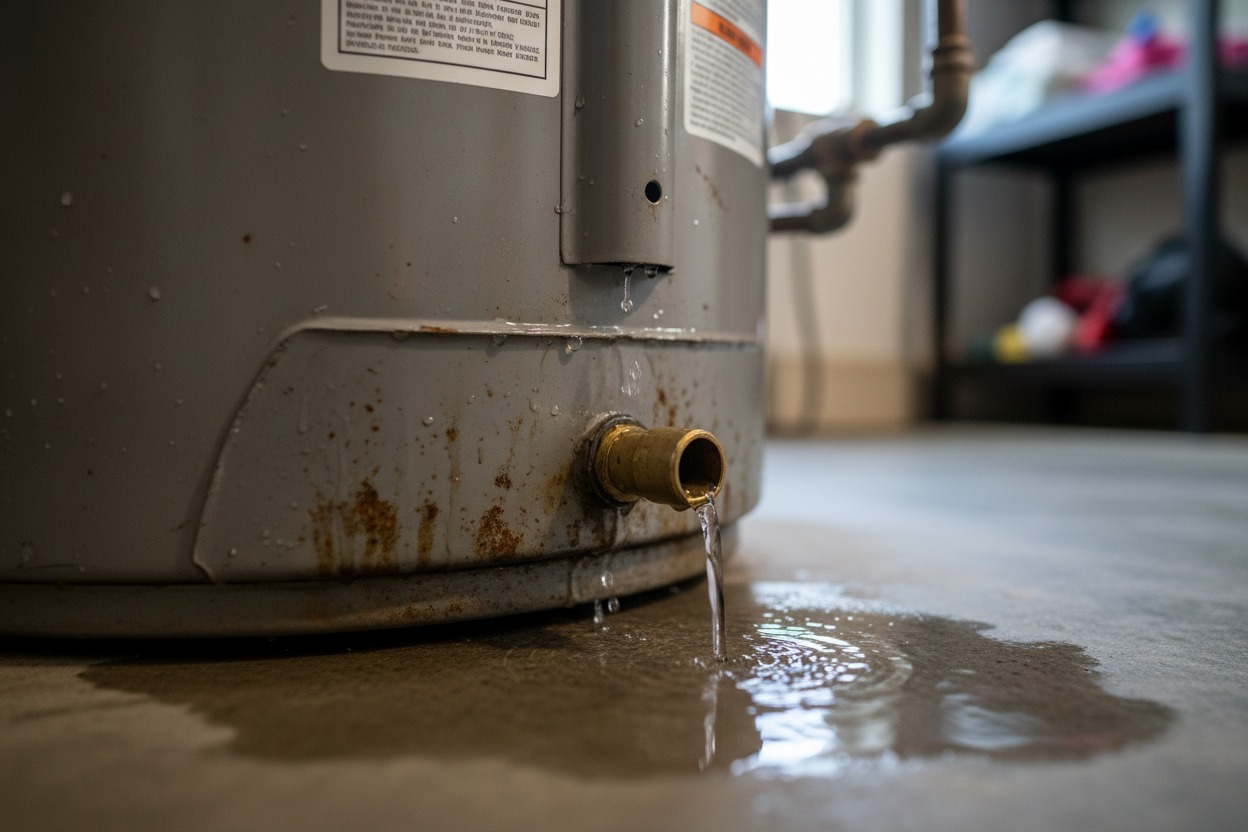
- Bottom of the tank or the tank seam: this usually means the tank has corroded through. A leaking tank cannot be patched, and the heater generally has to be replaced.
The longer a leak runs, the more it costs in ruined drywall, flooring and stored items. If the leak is coming from the tank itself, shut off the water supply and do not wait for it to get worse.
No hot water: quick checks before you call
If the heater has simply stopped heating and nothing is leaking or smells like gas, it is usually not an emergency. Check that the heater’s breaker has not tripped, then call so a specialist can tell you what is wrong. If you notice a gas smell at any point, stop and use the gas-smell steps above.
Gas smell, pilot trouble or a burning smell
Treat a gas smell as an emergency. Greer CPW, which supplies natural gas in the area, warns people not to rely on smell alone, and says to leave the area, avoid creating sparks, and call 911 and then CPW at 864-848-5500. A water heater is a gas appliance that can leak at the supply line, the control valve or the burner area.
Customers with propane should call their propane supplier after calling 911. A scorched smell, soot around the burner access panel, or flames rolling out of the bottom of the heater are also reasons to shut the heater down and call right away.
Hissing or steady discharge from the relief valve
Popping or rumbling is usually sediment and can wait for a normal call. A hissing sound, or water running steadily from the relief valve pipe, is different. The valve is releasing heat or pressure, so shut off power or gas, never plug or cap the valve, and call right away.
Emergency water heater repair or replacement?
Some failures are normal repairs: a thermostat, a heating element, a thermocouple, a relief valve or a drain valve. A failed tank is not. Rust-colored water, a tank that is leaking from the bottom, repeated failures in a short time, and an older unit are all signs that putting more money into repairs may not make sense.
Check the data plate on the side of the heater. The serial number usually shows when it was made. If you end up needing a new unit, see how sizing, fuel type and installation work on our page about what to expect when a tank heater has to be replaced.
Emergency water heater repair help around Greer
Greer sits across Greenville and Spartanburg counties, and homes here range from newer subdivisions to older houses with water heaters tucked into garages, attics and crawlspaces. A heater in an unheated space gets less margin on a cold Upstate night, and a leak in an attic can run down through the ceiling before anyone notices.
Call and stay on the line to be connected with a local water heater specialist who serves Greer. You can also see the towns around Greer we cover if you are just outside the city. Exact pricing depends on what is wrong, so call for exact pricing instead of relying on an online guess.
What to have ready when you call
- Whether the heater is gas, electric or tankless, and roughly how old it is
- Where the water is coming from, and whether it is steady or a drip
- Whether you have shut off the cold-water supply and the power or gas
- Any noises, smells, error codes or tripped breakers
- Whether the heater is in a garage, closet, attic or crawlspace, and whether you can reach it safely
Frequently asked questions
What should I do first if my water heater is leaking?
Turn off the power or gas to the heater, close the cold-water supply valve on top of the tank, and keep everyone out of any standing water near outlets. Then call for help. If you smell gas, leave the house and call 911 from outside before anything else.
Is a leaking water heater an emergency?
It depends on the source. A steady leak from the tank, water near electrical equipment, or a leak you cannot stop with the cold-water supply is an emergency water heater repair. A slow drip at a fitting is less urgent, but it should still be looked at soon.
Can I keep using a water heater that is leaking a little?
It is not a good idea. A small leak can turn into a larger one, and constant moisture damages floors and framing. If you are unsure where the water is coming from, shut off the cold-water supply and the power or gas until someone has checked it.
Why is my water heater on but there is no hot water?
On an electric heater it is often a tripped breaker, a tripped high-limit reset, or a failed element or thermostat. On a gas heater it is often an out pilot or a worn thermocouple. A gas smell changes the question completely, so leave the house and call 911 first.
How do I find the cold-water shutoff for my water heater?
Look at the pipes on top of the heater. The cold-water supply is the pipe with a handle or lever valve above the tank, usually on the right when the hot outlet is on the left, though not always. If that valve will not turn, close the main water valve for the house.
Do you give a price over the phone?
Exact pricing depends on the problem, the fuel type and the parts needed, so call for exact pricing. Describing the symptoms and the age of the heater helps the specialist tell you what to expect.